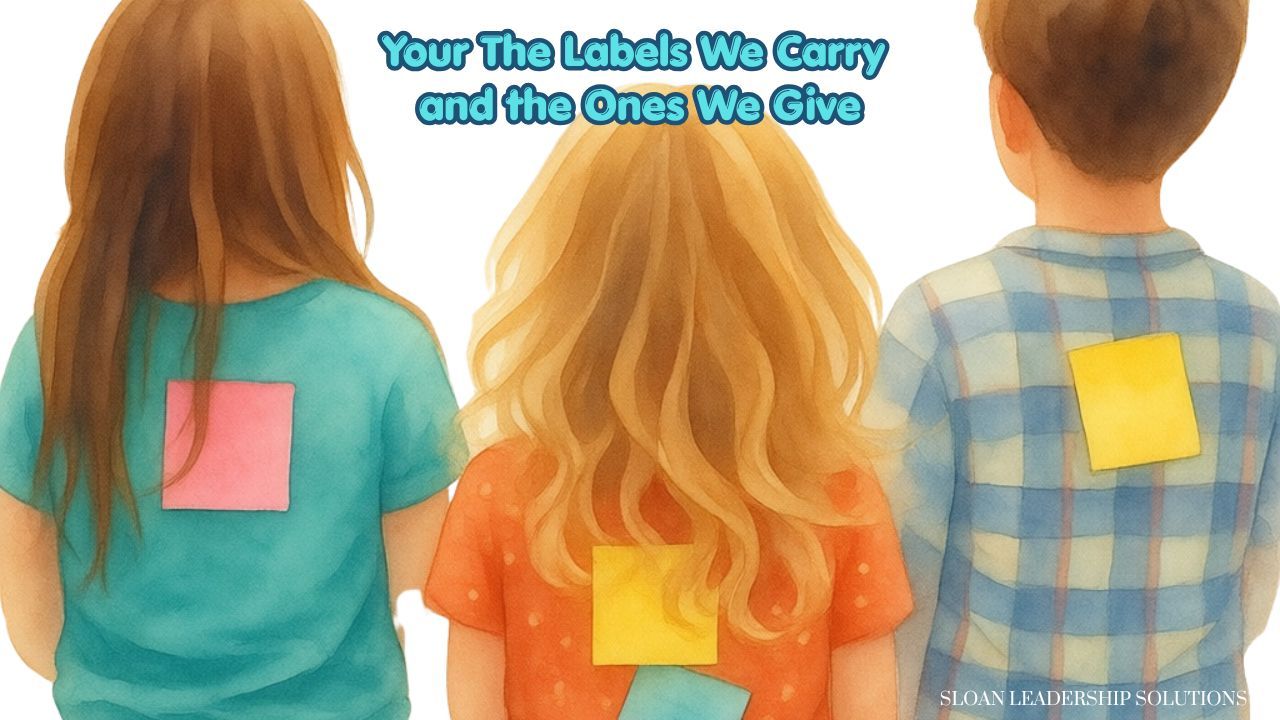
I recently listened to a story that reminded me of the importance of our words. It was about a principal who, as a child, was labeled “a problem.” She talked too much. She asked too many questions. She didn’t fit the mold of what her teachers expected.
At one point, a teacher told her to "shut up" for talking too much. Another teacher took it even further and offered her an A if she would simply stop talking for the rest of the year. It eventually became how she saw herself.
Think about that for a moment.
A child being rewarded not for learning, not for thinking, not for engaging, but for disappearing.
That’s the danger of labels. They don’t just describe behavior. They start to define identity.
When a student hears that they are a “problem” enough times, they begin to believe it. And once that belief takes root, it shapes decisions, confidence, relationships, and effort. Labels don’t stay in the classroom. They follow students into hallways, into homes, and eventually into adulthood.
This should cause us to pause as school leaders. Because this is not an isolated story or a rare moment in education. It happens in subtle, everyday ways that are easy to overlook. A comment made in frustration, a label repeated in a meeting, or a pattern of language that slowly begins to define a student more than their potential ever does. Over time, those words carry weight, and that weight begins to settle into how a student sees themselves and what they believe they are capable of doing or becoming.
What makes this especially important for us is the role we play in shaping the language and culture of our schools. The way students are talked about in classrooms, in team meetings, and even in casual conversations is influenced by what we model, what we allow, and what we choose to correct. We set the standard for whether students are described in ways that limit them or in ways that leave room for growth.
Of course, behavior needs to be addressed. Classrooms need structure, and teachers need support in managing real challenges. This is not about ignoring what is difficult or pretending that certain behaviors are acceptable when they are not. It is about being intentional in how we respond. There is a significant difference between addressing a behavior and attaching that behavior to a student’s identity. When a student is consistently described by their most challenging moments, it becomes increasingly difficult for them to see themselves any other way.
Over time, those descriptions can follow students far beyond the classroom. They influence how students approach new situations, whether they are willing to take risks, and how they interpret success and failure. They shape confidence in ways that are not always visible in the moment but become clear over the years. This is why our role carries such a deep level of responsibility. We are not simply responding to what is happening in front of us; we are influencing how a student will carry themselves into the future.
Because of that, it is worth taking a closer look at the words being used within our schools. It is worth asking whether those words are creating pathways for growth or quietly placing limits on students before they have had the chance to fully discover who they are. The truth is, we may not always see the long-term results of what we say, but that does not lessen their impact. If anything, it makes our words even more important.
We are shaping lives, often in ways that are not immediately visible, and that kind of influence calls for a level of awareness and intentionality that cannot be taken lightly.