
The Gap Between Knowing and Doing
Mar 25, 2026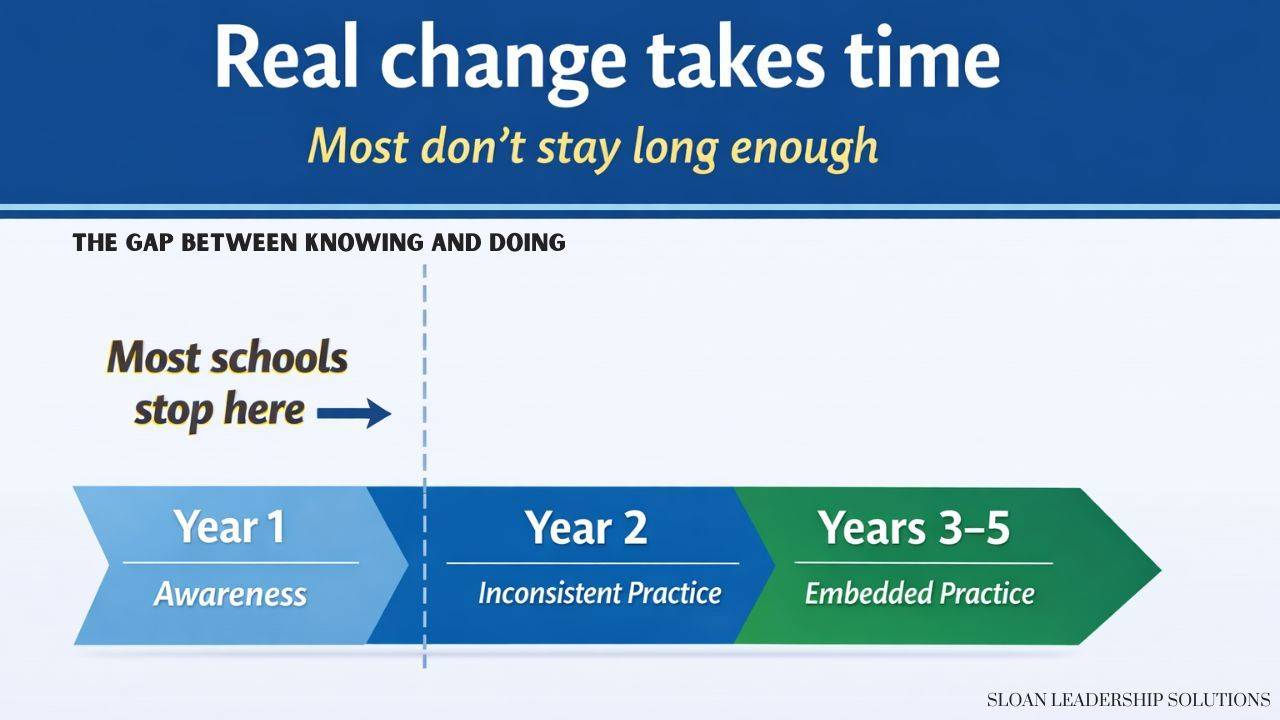
Walk into almost any school and you will find good ideas everywhere. There are research-based strategies, thoughtful professional development sessions, and initiatives that started with genuine excitement. In those early moments, everything feels aligned. The vision is clear, the purpose makes sense, and the plan feels strong.
And yet, a few months later, very little has actually changed in practice.
This is one of the most frustrating realities of school leadership. It is not a lack of knowledge that holds schools back. It is the gap between knowing and doing.
As leaders, we often assume that once something is introduced clearly, it will naturally transfer into daily practice. If teachers understand the strategy, if the team agrees with the direction, if the plan is well-communicated, then implementation should follow. But that assumption is where things begin to break down.
Understanding an idea and consistently applying it are two very different things.
In my work with principals, I see this pattern often. A leader introduces a strong, research-aligned initiative. The staff is on board. There is initial momentum. But without intentional follow-through, the work slowly fades. Not because people are unwilling, but because they are unclear on what it actually looks like to carry the work forward every single day.
This is where purpose becomes critical.
Purpose is not just the reason behind the initiative. It is the anchor that keeps the work from drifting when things get busy, complicated, or unclear. When purpose is clearly defined and consistently communicated, it gives meaning to the practice. It answers the question of why this matters, not just in theory, but in the real, daily decisions happening in classrooms and meetings.
However, purpose alone is not enough. Leaders must also build the bridge between purpose and practice.
This is where implementation becomes the hardest part of leadership.
Research on implementation consistently shows that meaningful, lasting change takes time—often three to five years to fully take root. That timeline is longer than most leaders expect, and it requires a level of patience and persistence that can be difficult to sustain in the fast pace of school leadership.
What often happens instead is a cycle that feels productive but ultimately prevents real progress. A new idea is introduced. There is a short burst of effort. Results are not immediate or consistent. The initiative is labeled as ineffective, and the team moves on to something new.
Over time, this creates a deeper issue. Staff begin to expect that initiatives will come and go. Commitment weakens, not because people do not care, but because they have learned that the work may not last.
Closing the gap between knowing and doing requires a different approach.
Leaders must slow down long enough to truly assess where their team is. This goes beyond looking at data on a spreadsheet. It requires listening to teachers, observing classrooms, and understanding where confusion or inconsistency exists. What feels clear at the leadership level is often experienced very differently in practice.
From there, the work must be intentionally designed. Not just the idea itself, but the day-to-day application of it. What does this look like during instruction? How should it show up in team meetings? What specific actions are expected, and how will those actions be supported? Without this level of clarity, even the best ideas remain inconsistent.
Finally, everything must be aligned. The focus cannot shift every few weeks. Meetings, walkthroughs, feedback, and conversations all need to reinforce the same priorities. This consistency is what allows a new practice to take hold and become part of the culture rather than just another initiative.
This kind of leadership requires restraint. It requires choosing depth over speed and consistency over constant change. It also requires the willingness to stay committed long after the initial excitement has faded.
The real question for leaders is no longer, “Do they understand it?” but rather, “Are we seeing it consistently in practice?”
Because consistency is where impact lives.
Stay connected with news and updates!
Join our mailing list to receive the latest news and updates from our team.
Don't worry, your information will not be shared.
We hate SPAM. We will never sell your information, for any reason.
