
The Knowing-Doing Gap
Jun 06, 2026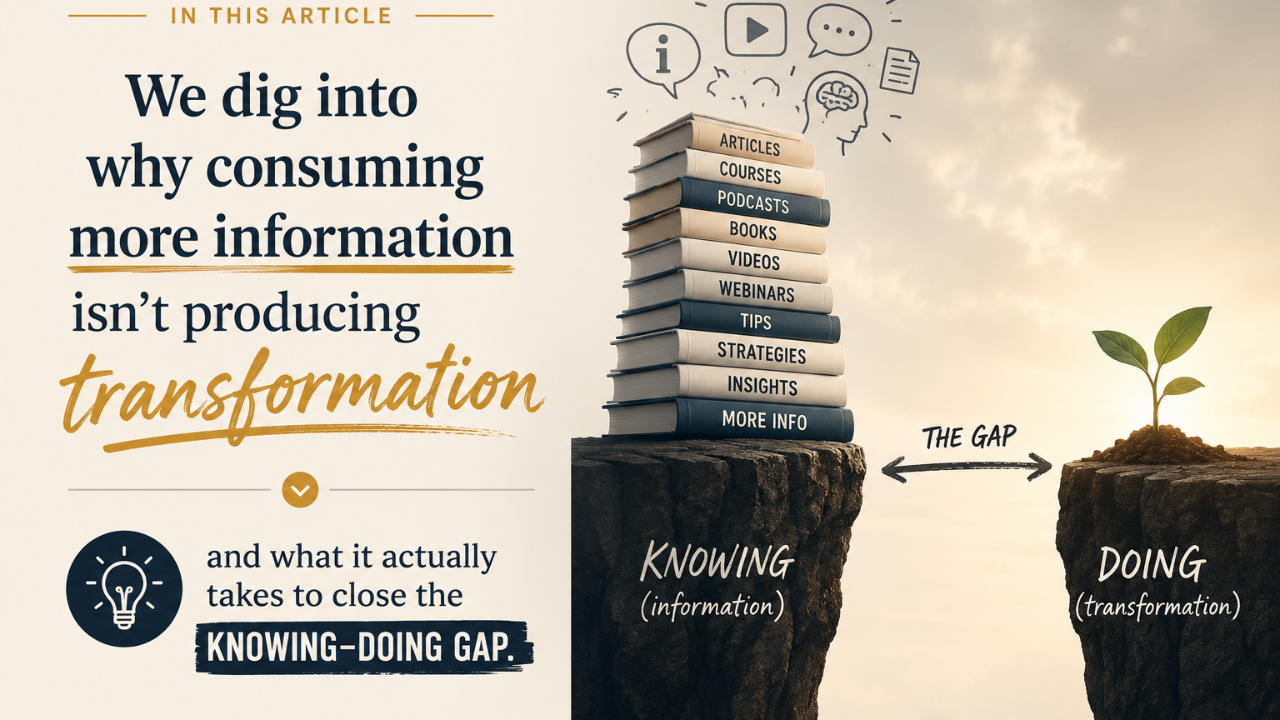
You have read the books. Attended the conferences. Sat through the professional development sessions. You have highlighted, bookmarked, and taken notes on more leadership content than most people will consume in a lifetime.
And you are still leading the same way you did three years ago.
That's the gap I'm talking about.
Consuming information feels productive. It is easy to walk away from a conference or finish a book and feel like you've done the work. But information sitting in a notebook isn't transformation. Transformation happens when what you've learned disrupts how you actually behave, and that disruption is rarely comfortable.
Reading about change and actually changing are not the same thing.
Knowing something doesn't require you to change. Applying it does. And real change means admitting that what you were doing before wasn't working. That costs something. So instead of changing, we consume more. Another book. Another podcast. Another session. It feels like growth. It has the shape of progress. But it isn't moving you.
Information gives you the sensation of growth without the risk of it.
Teachers are living this same gap with students.
Every teacher has stood in front of a class and delivered a lesson that seemed to go well; students nodded, participated, and seemed to get it. And then the assessment came back, and it was clear they hadn't applied any of it.
Students need the same bridge leaders do. They need to be asked not just what they learned but what they can do with it. They need low-stakes opportunities to practice, fail, and try again. They need a teacher who creates space for application, not just acquisition. The classroom that produces transformation is not the one that delivers the most content. It's the one where students are regularly asked to use what they know.
Principals can close this gap for teachers.
If you want teachers who grow, stop measuring professional development by hours logged and start asking better questions. In your next observation debrief, don't just discuss what you saw. Ask what the teacher has been learning lately and where they are trying it. In your next team meeting, create space for teachers to share not what they read but what they changed.
Model it yourself. Tell your staff what you are working on. Tell them what you learned and what you are doing differently because of it. When leaders are transparent about their own knowing-doing gap, it gives everyone else permission to close theirs.
Transformation doesn't happen in isolation. It happens in a culture where growth is expected, supported, and visible.
The question is worth asking.
Not "what have I learned lately?" but "what have I changed lately?"
Those are very different questions. One measures consumption. The other measures growth. The leaders who make the biggest impact aren't the ones who know the most. They're the ones who let what they know actually change them.
This is where a coach changes everything.
A coach doesn't give you more information. You already have plenty. A coach asks you the questions that force you to close the gap. What did you learn, and what did you actually do with it? What are you avoiding and why? What would have to change about how you lead for this to be different next year?
A good coach holds up a mirror. They don't let you stay comfortable in knowing. They push you toward doing. That accountability, someone in your corner who won't let you off the hook, is what moves information into transformation. Most leaders who are stuck don't need another book. They need someone who will ask them hard questions and stay in the room while they answer.
Stay connected with news and updates!
Join our mailing list to receive the latest news and updates from our team.
Don't worry, your information will not be shared.
We hate SPAM. We will never sell your information, for any reason.
