
Three Things Great Principals All Have in Common
Sep 18, 2026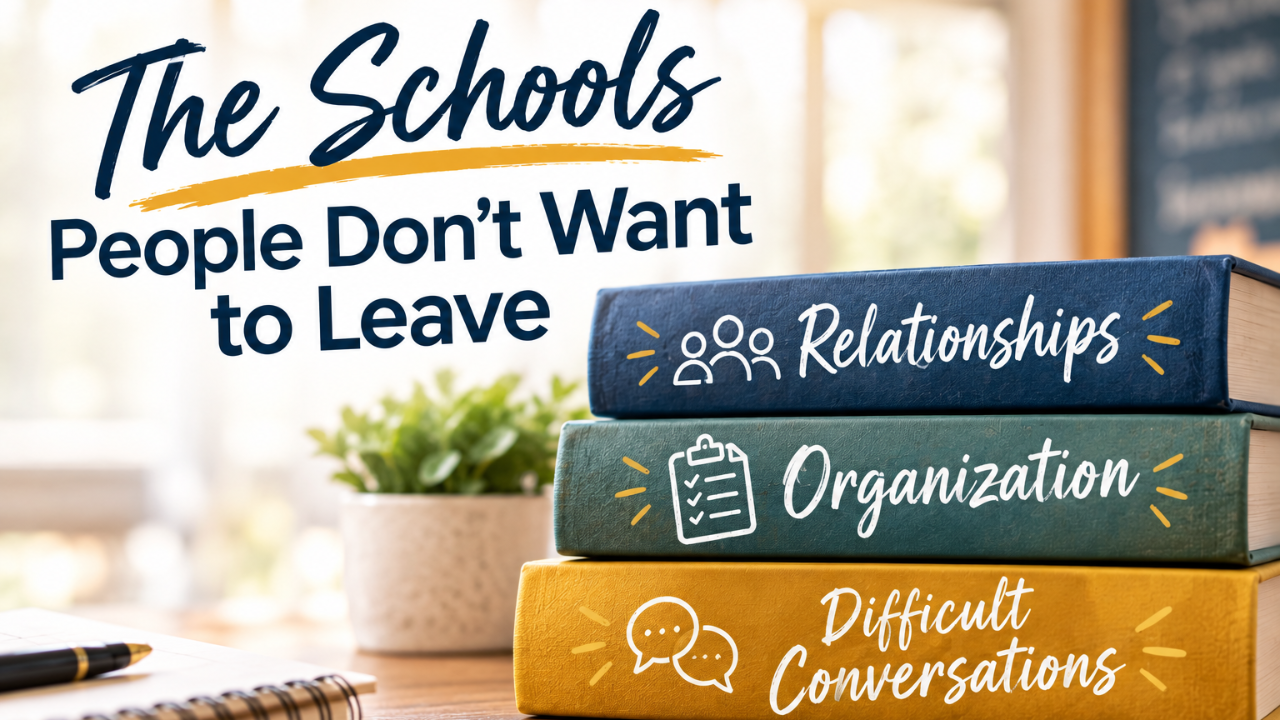
1. They Build Real Relationships
Research on teacher retention consistently points to the same finding: principal support is one of the strongest predictors of whether a teacher stays or leaves. A study of New York City schools found that principal leadership was the single strongest predictor of teacher retention, particularly in schools where principals built supportive evaluation systems and made room for teacher voice in decisions. Separate research on principal-teacher relationships in low-performing, high-turnover schools found the same pattern: teachers who trusted their principal and felt communicated with effectively stayed longer, even in the hardest working conditions.
The research points to a few specific things that build that trust over time:
- Consistent, honest communication
- Teachers having real input into decisions that affect them
- Feeling supported rather than evaluated from a distance
The leaders I coach whose staff would follow them anywhere aren't the ones with the flashiest vision statements. They're the ones who make people feel like a whole person instead of a role to be managed, and the research backs up why that matters so much for keeping good teachers in the building.
2. They Are Organized
The most beloved principals are often the most organized. That kind of organization means the building runs on a rhythm people can count on: clear goals, data-backed decisions, and time and resources managed well enough that the day holds together.
Researchers studying what separates high-impact principals from the rest found that this kind of organizational skill was directly connected to:
- Higher student achievement growth
- Higher teacher satisfaction
- A stronger school climate
When a school feels unpredictable, teachers spend energy bracing for the next surprise:
What is changing now?
Who is responsible for this?
Why did I hear about this from someone else?
Will this expectation still matter next week?
That constant uncertainty is exhausting. It pulls attention away from students and toward self-protection.
Research has linked strong school leadership and effective organizational conditions with better teacher satisfaction, school climate, and student outcomes. Research also finds that schools with better administrative support, stronger collaboration, and more effective principal leadership are better positioned to retain teachers.
When a principal I'm coaching gets this piece right, I see it ripple through the whole staff almost immediately. People stop bracing for chaos. That predictability frees people up to focus on their work instead of managing uncertainty.
3. They Are Willing to Have the Hard Conversations
This is the one I see leaders avoid most, and I get why. A principal's hard conversations come from every direction:
- The teacher whose lesson plans haven't been turned in for three weeks straight
- The parent who shows up furious because their child got suspended and they think it's unfair
- The student who needs a real consequence but still needs to know you're in their corner
- The board member pushing back on a decision you made
- The superintendent asking about test scores and wanting answers on your implementation plan
- The neighbor who calls the district every time car pickup traffic blocks their driveway
Researchers studying principals navigating performance conversations describe them as some of the most emotionally loaded moments in the job, and many principals were never actually taught how to have them, with a teacher, a parent, or anyone else on the other side of the desk.
So the conversation gets pushed back a week. Then a month. Staying quiet doesn't protect a relationship; it erodes it. When a leader stays silent, the other person doesn't assume things are fine. They assume either nothing was noticed, which costs credibility, or something was noticed, and no one cared enough to say so, which then costs trust.
The goal of a hard conversation is not to win, intimidate, or prove authority. It is to protect the person, the team, the standards, and ultimately the students.
The best principals enter these conversations with both clarity and dignity. They name what is true. They explain why it matters. They listen. They establish next steps. And they leave the other person knowing that accountability and support can exist in the same conversation.
Every principal I've coached through this has told me something like this afterward: the conversation they dreaded for weeks took ten minutes and fixed something that had been quietly wrong for months. It didn't matter who was on the other side of the table.
These three things work together.
Relationships give people a reason to stay.
Organization gives them a school worth staying in.
And hard conversations keep it honest.
Stay connected with news and updates!
Join our mailing list to receive the latest news and updates from our team.
Don't worry, your information will not be shared.
We hate SPAM. We will never sell your information, for any reason.
